

THE BLACK AVANT-GARDE

What happens when a pair of pantyhose becomes a sculpture, a snowball becomes a work of conceptual art, or discarded objects become a confrontation with American history? Across generations, Black artists have challenged the very definition of art, transforming ordinary materials into extraordinary forms of expression. Their experiments have moved between abstraction, assemblage, performance, and conceptual practice, expanding the possibilities of artistic creation while questioning who gets to determine what qualifies as art. These artists were not simply responding to the conventions of their time. They were developing new artistic languages that would become part of the foundation of contemporary art.
By the 1960s and 1970s, artists such as Betye Saar, David Hammons, Senga Nengudi, and Howardena Pindell were pushing artistic experimentation in remarkably different directions. Their work emerged alongside broader transformations in American art, yet their contributions were not always afforded the same visibility or historical recognition. Some confronted racial representation directly, while others explored the body, abstraction, material, and movement without limiting their practices to a singular cultural narrative. Together, they challenged the assumption that Black art could be defined by one subject, aesthetic, or purpose, demonstrating that artistic innovation was as much about the freedom to experiment as it was about the ideas being expressed.
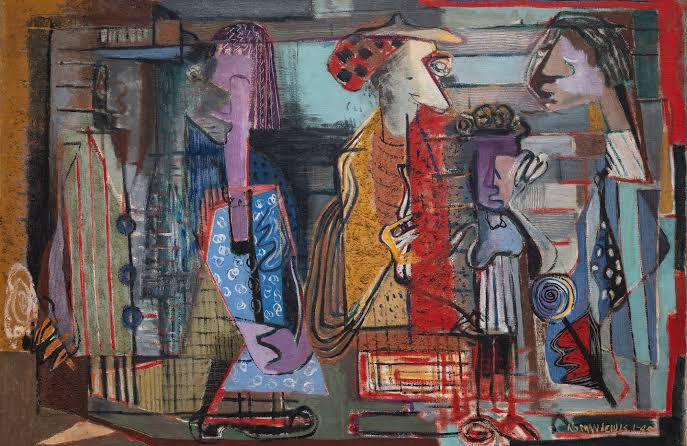
During the twentieth century, Black artists participated in and helped shape some of the most significant developments in modern art. Norman Lewis developed an abstract painting practice that engaged questions of movement, atmosphere, and form while navigating an art world that frequently marginalized Black abstractionists. Alma Thomas explored color and rhythm through compositions that challenged the assumption that Black artistic expression had to be explicitly figurative or political. By the 1960s and 1970s, experimentation had expanded beyond painting into assemblage, performance, installation, and conceptual art. Artists were increasingly questioning the distinction between art and everyday life, introducing materials that had little connection to traditional sculpture or painting. Black artists were central to those conversations, even when their contributions received less institutional attention.
Betye Saar emerged as a particularly important figure in this expansion of artistic language. Working with found objects, photographs, domestic materials, and discarded imagery, Saar developed assemblages that transformed familiar objects into complex statements about history, spirituality, and racial representation. Her 1972 work The Liberation of Aunt Jemima confronted a racist caricature by reimagining the figure through the visual language of resistance and empowerment. Saar's approach demonstrated how objects already circulating through American culture could be dismantled and given entirely different meanings. Rather than separating artistic experimentation from political consciousness, she brought the two together, challenging both the materials considered worthy of fine art and the images through which Black identity had been represented.
Around the same period, David Hammons was developing an equally unconventional practice that questioned the relationship between artistic value, race, and the institutions responsible for determining cultural importance. His early body prints used grease and pigment to create impressions of the human figure, while later works incorporated materials such as hair, bottle caps, and other objects associated with everyday life. Hammons also brought his practice into public space, often working outside the conventional gallery system. His 1983 performance Bliz-aard Ball Sale, in which he arranged and offered snowballs for sale on a New York City sidewalk, challenged assumptions about authorship, commerce, and what qualifies as an artwork. The gesture was deceptively simple, yet it exposed the systems through which ordinary materials acquire artistic and economic value.

Senga Nengudi approached experimentation through the relationship between sculpture and the human body. Beginning in the 1970s, she developed her R.S.V.P. series using nylon pantyhose stretched, knotted, and weighted with sand. The resulting forms sagged, expanded, and responded to gravity, resembling bodies under pressure or in motion. Performers sometimes interacted with the sculptures, transforming them into environments for movement rather than objects intended only for observation. Nengudi's work challenged the rigidity traditionally associated with sculpture while exploring elasticity, transformation, vulnerability, and endurance. Through inexpensive materials associated with everyday life, she created a sculptural language that was physically expressive and difficult to confine to a single discipline.
Working within overlapping experimental circles in Los Angeles, Maren Hassinger also explored how unconventional materials could transform the experience of sculpture. Industrial wire rope became central to her early practice, allowing her to create forms that suggested organic movement despite their manufactured origins. Her installations and performances frequently examined relationships between the body, nature, and constructed environments. Alongside Nengudi and other artists connected to the experimental Black arts community in Los Angeles, Hassinger helped establish a practice in which movement, material, and performance could exist together. Their work complicates conventional histories of the avant-garde by demonstrating that some of its most inventive approaches were developing within Black artistic communities that were not always centered in dominant institutional narratives.

Howardena Pindell pursued another direction through abstraction, surface, and process. Her paintings incorporated layers of color, paper circles created with a hole punch, numbers, and textured materials that expanded the possibilities of the painted surface. Pindell's experimentation was never limited to formal concerns. In her 1980 video Free, White and 21, she directly confronted experiences of racism and the dismissal of Black women's perspectives, moving between personal testimony and performance. The relationship between these different bodies of work reveals the range of her practice. Pindell could investigate abstraction through color and repetition while also creating politically explicit conceptual work, refusing the expectation that an artist must remain within one recognizable mode of expression.
Although these artists developed distinct practices, their work shared an interest in questioning what art could contain. Everyday objects became sculpture. The body became both material and performer. Abstraction offered possibilities beyond representation, while conceptual gestures challenged the systems that assigned value to artistic objects. Their experimentation also developed through relationships, communities, and exchanges of ideas rather than isolated moments of individual genius. Black artistic innovation was not happening outside the broader history of contemporary art. It was actively participating in its transformation.
Contemporary artists continue to expand that language through new materials, technologies, and approaches to cultural memory. Kevin Beasley, for example, creates sculptural works and installations incorporating cotton, clothing, resin, and sound. His practice investigates the relationships between material, labor, history, and the body, often transforming recognizable objects into dense sculptural forms. In works involving cotton, the material's physical properties exist alongside its historical associations with agricultural labor and slavery in the United States. Yet Beasley's work cannot be reduced to historical symbolism alone. Its experimentation with texture, sound, preservation, and physical transformation demonstrates how contemporary sculpture can communicate through multiple sensory and conceptual experiences at once.

Across these practices, the avant-garde becomes less about belonging to a particular movement and more about the freedom to question the conditions under which art is created and understood. Black artists have not approached experimentation through a single aesthetic or political position. Some have confronted racial imagery directly, while others have pursued abstraction, material research, performance, or conceptual investigations that resist immediate interpretation. Their differences are essential to understanding the breadth of Black artistic expression. A Black artist's decision to create an abstract painting, an unconventional sculpture, or a work that appears disconnected from questions of identity does not diminish its place within Black cultural history.
Recognition, however, remains an important part of the conversation. Art institutions have historically influenced which movements become central to the canon and which artists are positioned as pioneers. Exhibitions, collections, criticism, and art historical scholarship determine how innovation is remembered and taught. As museums and scholars revisit experimental Black art, practices once overlooked or insufficiently recognized are receiving greater attention. But recognition should not be confused with discovery. Many of these artists developed influential bodies of work and sustained artistic communities long before broader institutions began reconsidering their significance.
Perhaps the most compelling aspect of the Black avant-garde is its resistance to the idea that Black creativity must be understood through a fixed set of expectations. Artistic freedom includes the ability to address race and history, but it also includes the freedom to explore beauty, absurdity, material, abstraction, humor, movement, and ideas that have no immediate explanation. Black artists have continually demonstrated that experimentation is not separate from their cultural experience, nor does every experiment need to serve as a direct statement about identity. Their work belongs to the history of artistic innovation because of what it contributes to art itself.
Looking across generations, the Black avant-garde reveals a history of artists who have expanded the possibilities of painting, sculpture, performance, and conceptual practice while challenging the boundaries imposed upon their work. Their contributions are not simply additions to an established narrative of modern and contemporary art. They invite us to reconsider how that narrative was constructed and whose experiments helped shape it. To understand the avant-garde more fully is to recognize that Black artists have long been among those redefining what art can become, whether or not the establishment was prepared to recognize their work at the time.


Comments