

Mapping the Movement: Black Bookstores Launch Their First National Directory

Across the United States, Black owned bookstores have long served as more than places to purchase books. They have been spaces where culture, history, and community gather. For decades these stores have introduced readers to Black authors, hosted conversations that shape communities, and preserved stories that might otherwise be overlooked.
Now, for the first time, those spaces are being connected through a national directory.
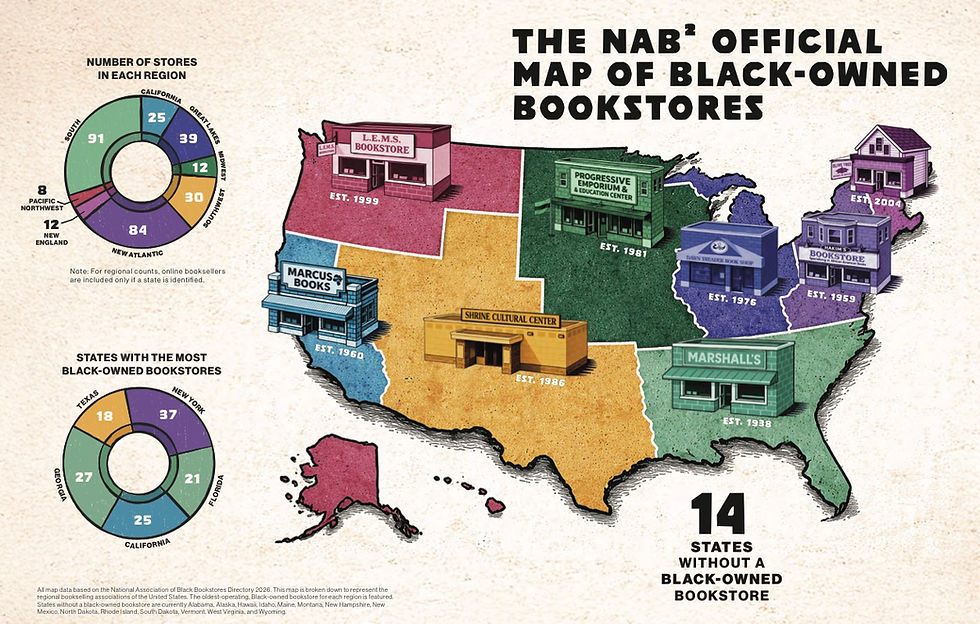
The new resource was launched by the National Association of Black Bookstores, a nonprofit organization working to strengthen the visibility and sustainability of Black owned literary spaces across the country. The directory creates a centralized place where readers can discover and support these bookstores, something that has never existed on a national scale until now.
The launch also comes with a clearer picture of the current landscape. According to research from the organization, there are currently 306 Black owned bookstores operating in the United States, representing about 8 percent of independent bookstores nationwide.
While the number reflects a growing presence, the data also highlights how fragile the ecosystem remains.

Fourteen states currently have no Black owned bookstore at all, creating significant geographic gaps in access to spaces that specialize in Black literature, history, and culture. For readers and communities in those areas, discovering books by Black authors often depends on mainstream retailers that may not prioritize or curate those voices in the same way independent bookstores do.
Financial sustainability is another challenge. Nearly 90 percent of Black owned bookstores report annual revenue under $250,000, illustrating how many of these businesses operate on tight margins while still functioning as cultural hubs for their communities.
Perhaps the most surprising finding is related to publishing trends. Even as overall print book sales have increased in recent years, sales of books by Black authors declined by 14 percent. The shift raises important questions about visibility, marketing, and how Black stories are reaching readers within a changing publishing industry.
The new directory hopes to address several of these challenges by improving discovery and connection. By giving readers, educators, and institutions a centralized tool to locate Black owned bookstores, the initiative encourages more consistent support and greater awareness of the role these stores play.
For many bookstore owners, the project represents something deeper than a listing. It acknowledges the cultural importance of Black bookstores as institutions that have historically nurtured writers, hosted political and social dialogue, and provided spaces where readers can see their experiences reflected on the shelves.
Throughout history, Black bookstores have helped introduce generations of readers to authors whose work shaped literature, activism, and cultural thought. From poetry readings and book signings to community discussions and youth programs, these stores have often functioned as informal cultural centers within their neighborhoods.
Today, many of them continue that legacy while also navigating the realities of operating small independent businesses in an industry dominated by large retailers and digital platforms.
The new directory is one step toward strengthening that network. By making Black owned bookstores easier to find, the National Association of Black Bookstores hopes to expand the audience supporting them and ensure that these spaces continue to thrive.
In a literary landscape that is constantly evolving, the directory serves as both a resource and a reminder. The stories that shape culture do not exist in isolation. They are supported by the communities, bookstores, and readers who keep them alive.


Comments