

Rituals of Time and the Future of Memory

There are ways of understanding time that have little to do with clocks. Time can live in a body, return through ritual, survive through an object, or remain present in stories passed between generations. It can move backward as easily as it moves forward, resurfacing through memory while simultaneously shaping what has yet to happen. This more expansive relationship to time sits at the center of Rituals of Time, a group exhibition at Load Gallery in Barcelona bringing together nine African artists whose practices move through ancestry, memory, spirituality, technology, displacement and imagined futures. On view through January 16, 2027, the exhibition features Michael Aboya, Àsìkò, John Baloy, Alexis Chivir-ter Tsegba, Delphine Diallo, Nana Frimpong Oduro, Osinachi, Melissa Simon-Hartman and Abdulrahman Adesola Yusuf across photography, video, digital collage, artificial intelligence and textile sculpture. Yet the exhibition is less interested in assembling different interpretations of a shared theme than in questioning the framework through which time itself is often understood. Rather than accepting the familiar progression of past, present and future as distinct territories, Rituals of Time allows them to fold into one another. Memory becomes active rather than archival. Ancestry is not confined to history, and the future is not imagined as a destination entirely disconnected from what came before. Time operates through return, repetition and transformation, creating a space where remembering can also become an act of creation.

Central to this conversation is Mbari, the communal artistic and spiritual tradition associated with Owerri-Igbo communities in southeastern Nigeria. Historically, Mbari houses were elaborate environments created collectively in response to spiritual and communal life, filled with sculptural forms and imagery reflecting the world of the people who made them. Their significance did not exist solely in the preservation of a finished object. Creation itself was part of the meaning. Nigerian writer Chinua Achebe described Mbari through an aesthetic rooted in process rather than result, allowing creation to move between generations rather than become fixed within one moment. At Load Gallery, that impermanence takes on a contemporary form as images appear and disappear across screens, turning the digital surface into a threshold between what has been, what remains and what has yet to emerge. Kenyan philosopher John S. Mbiti offers another way into this relationship between time and memory. His writing on African concepts of time considers experience through the events that constitute it, with memory connecting the immediate world of the living to a more distant past. His concept of the “living-dead” describes those who have physically died but remain present within the memories of people who knew them before eventually passing into collective remembrance. Seen alongside Rituals of Time, these ideas give greater weight to the exhibition’s refusal to treat ancestry as something sealed away from contemporary life. What might initially appear to be a collision between ancestral tradition and technological experimentation instead reveals how incomplete that separation has always been. Culture is continually produced through inheritance and revision. Each generation receives something, changes it and passes something different forward.

Memory takes physical form in the practices of Michael Aboya and Alexis Chivir-ter Tsegba, where recollection is less about retrieving an intact past than understanding how experience is continuously reconstructed. Aboya’s Echoes of Time visualizes fragments of human memory through what the artist describes as distinct “time-bodies” of birth, growth, love, silence and renewal. Across nine digital works, earth, air, fire and water cease to function simply as physical environments and instead become states of being, while light, movement and texture transform stillness into duration. At the center of the work is the convergence of Ìgbà, time, and Tizita, memory, allowing moments to dissolve and reappear rather than settle into a fixed chronology. Tsegba approaches this instability through what she calls a “collage brain,” a process built around assembling, disassembling, returning and recomposing. In At the Seams, Spilling, collage becomes more than technique. It becomes a way of moving through time. Bodies operate as porous thresholds, love functions as a form of timekeeping and ancestral knowledge remains capable of informing future possibilities. Her works move through African spiritual philosophies, intimacy, queer desire and diasporic experience without requiring past, present and speculative futures to exist separately. Both practices suggest that memory does not return to us whole. It arrives through fragments, associations, sensations and inherited histories, constantly altered by the person doing the remembering.

Questions of cultural transmission become especially pronounced in the dialogue between Àsìkò and Melissa Simon-Hartman. Àsìkò’s What Was Lost Between Worlds draws from Egúngún, the Yoruba ancestral masquerade tradition through which the living maintain relationships with the ancestral realm. Here, Egúngún becomes a living archive encoded through cloth, gesture, rhythm and ancestral presence. As a spectral trace of colonial architecture emerges, the figure begins to dissolve, releasing Adire patterns, Ifá binary marks and abstract data points into the surrounding space. Cultural knowledge appears suspended between disappearance and persistence, raising a question with particular significance across histories of migration, suppression and displacement: when embodied knowledge is severed from the conditions that sustained it, does it vanish or transform into another mode of being? Simon-Hartman’s Ancestral Frequency enters that question through material rather than digital dissolution. Constructed from handwoven fibers, reclaimed textiles, shells, beads and integrated lighting, the wearable sculpture draws upon the visual language of Egúngún without positioning itself as a reproduction of Àsìkò’s work. It gives ancestral presence weight, texture and the possibility of movement through a body. Memory can be worn, activated and carried through space. Placed in conversation, the two works resist the assumption that preservation requires cultural practices to remain frozen in their original form. Àsìkò allows embodied knowledge to break apart and enter another visual language, while Simon-Hartman gathers memory into something tactile and physically present. One considers what remains when form begins to disappear. The other asks what becomes possible when inheritance is given another body.


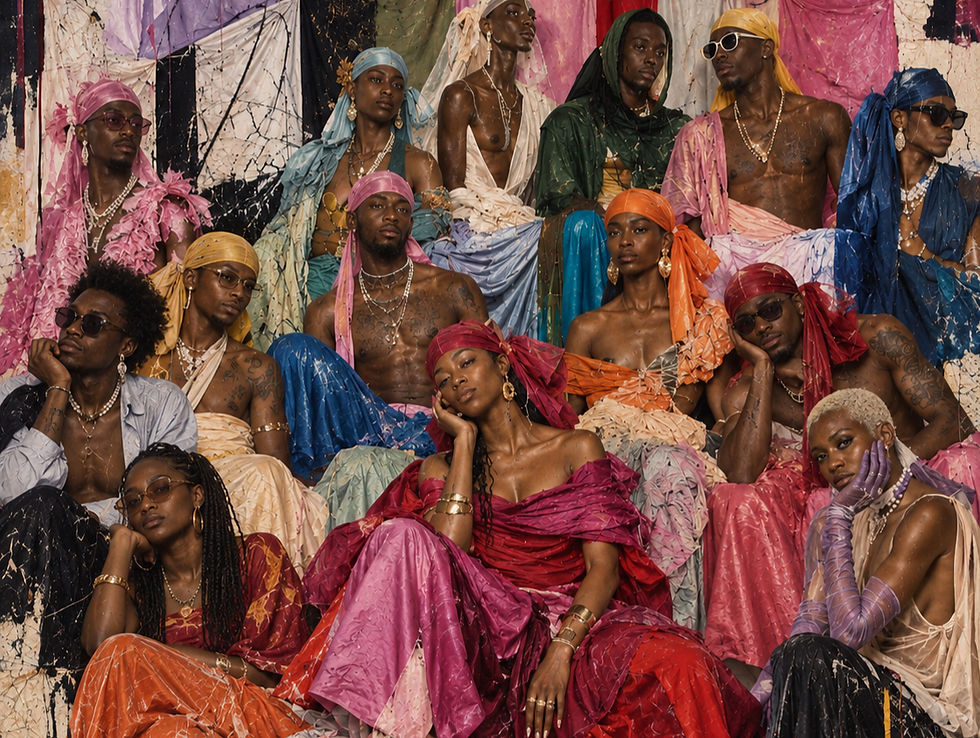
Elsewhere, John Baloy and Nana Frimpong Oduro locate time within the body and interior consciousness. In Baloy’s Feel the Sincerity of the Intention to Evoke Emotion, the body carries history through gaze, posture, color and gesture. Red cloth functions as a shield of vitality and remembrance, wrapping the figures in a visual language of protection while their stillness resists the expectation that strength must announce itself loudly. Ritual appears through presence rather than spectacle, and identity is understood as something lived rather than displayed. Memory, love and spiritual knowledge move through the body across generations, making embodiment itself a form of transmission. Oduro’s practice turns further inward, exploring the relationship between light, presence and consciousness through cosmology, philosophy and a visual rhythm he connects to the experience of music. Nostalgia and longing become particularly important here because neither is treated as passive attachment to what has already happened. They draw the past into the present while simultaneously reaching toward the future. Water, earth, fire and air become agents of bodily experience and ritual transformation, dissolving the boundary between inner consciousness and the material world. Across both practices, the archive expands beyond documents and preserved objects. It can exist through gesture, sensation, rhythm, spirituality and the body itself, allowing forms of knowledge that may never enter an official historical record to remain present.

Speculation opens another path through the exhibition as Delphine Diallo and Osinachi complicate the assumption that ancestry belongs to the past while technology belongs to the future. Diallo’s TA-NETER: THE ATLANTIC KINGDOM, part of her larger Motherverse project, imagines a submerged ancestral civilization beneath the Atlantic where ancient knowledge and future technology converge. Atlantis is reframed not simply as a lost mythical civilization but as the name history assigned to something older, while Ta-Neter becomes a realm in which the ancestors never disappeared. Oracles return as spiritual guardians carrying knowledge of perception, healing, transformation and future intelligence, surrounded by marine beings that function as part of the kingdom’s living consciousness. The Atlantic carries unavoidable histories of forced movement, rupture and loss for African and diasporic people, yet Diallo refuses to allow those histories to establish the limits of what the ocean can mean. Water becomes memory, gold becomes frequency and the submerged world becomes a site from which another relationship between ancestry and futurity can be imagined. Rather than escaping history to construct the future, TA-NETER asks what might become possible through remembering forms of intelligence that history has renamed, obscured or forgotten.

Osinachi arrives at that intersection through a tool so ordinary that its artistic possibilities can easily be overlooked. Working with Microsoft Word and its vector tools, the Nigerian artist transforms the visual language of office software into Black portraiture, domestic interiors, scenes of maternal care, Nigerian popular culture and Afrofuturist environments. Pixelated fills become representations of Black skin, while the technological limitations of the software become part of a visual language Osinachi has developed over nearly two decades. NKECHI, bringing together works created between 2019 and 2025, moves between childhood, family and speculative futures, but its title work pushes the exhibition’s questions about memory into particularly unfamiliar territory. Inspired by the Mona Lisa, Nkechi imagines a future in which a robot has moved beyond the role of tool or servant and become an irreplaceable member of a family. Commissioning its portrait becomes an act of remembrance, granting the machine the kind of permanence traditionally reserved for a person whose presence deserves to survive beyond a lifetime. The work destabilizes the boundary between technology and kinship. If ancestry is partly constructed through the people a family chooses to remember, what happens when technology enters that lineage? Osinachi does not present the digital world as something arriving after tradition. Technology becomes another place where family, cultural memory and inheritance might eventually reside.

For Abdulrahman Adesola Yusuf, memory moves through the less visible forces shaping everyday life. Relax, Yesterday Is Gone developed from visits to his childhood home and traces how seemingly small personal moments can carry spiritual weight while remaining connected to economic and security pressures. Working with symbols sourced from the public domain and wider internet, Yusuf redraws, repaints and recomposes them through a process he compares to playing Tetris, rotating and breaking apart visual fragments until they begin to form a coherent mythology. That continual revision mirrors the instability of memory itself, but Yusuf’s broader practice also introduces a structural dimension into the exhibition. His work considers how governmental systems, socioeconomic policies and material conditions enter daily experience so deeply that their effects can take on emotional and even spiritual dimensions. What we remember as personal is not always produced by personal circumstances alone. Homes, childhoods, fears, aspirations and beliefs are formed within systems that may remain largely invisible while shaping the conditions of a life. Relax, Yesterday Is Gone makes room for release without suggesting that moving forward requires erasure. Yesterday can be gone while its structures, lessons and consequences remain embedded in the present.
Across Rituals of Time, the familiar separation between ancestry and futurity begins to lose its usefulness. African cultural practices are often approached through the language of preservation, with tradition positioned as something that must be protected from change in order to remain authentic, while contemporary technology is framed as evidence of departure or rupture. The artists gathered here expose the limitations of that binary. Tradition has never survived by remaining completely unchanged. It survives because people continue to practice it, interpret it, question it and build from it. Egúngún can enter a digital environment without its cultural history becoming irrelevant. A textile sculpture can draw upon ancestral language while asserting a contemporary presence of its own. Microsoft Word can become a tool for Black portraiture. Artificial intelligence can participate in a visual cosmology concerned with ancestral knowledge. Collage can place queer intimacy and African metaphysics within the same temporal field. An imagined underwater civilization can transform one of the most historically charged geographic spaces of the African diaspora into a site from which another future can be conceived. None of these gestures require history to be discarded. They demonstrate how history remains alive because artists refuse to treat it as finished.

Beneath the exhibition’s engagement with duration, nostalgia and longing is a larger question about who gets to determine the relationship between history and possibility. Linear time encourages us to imagine the past as something completed, the present as something temporary and the future as territory that has not yet been touched. Cultural memory rarely behaves so neatly. The people who came before us remain present through language, gesture, ritual, photographs, clothing, belief, architecture, technology and countless habits inherited without always knowing their origin. Previous generations also imagined futures that we are now living inside. The distance between ancestor and descendant, memory and possibility, may therefore be much smaller than a conventional timeline suggests. Rituals of Time does not propose a singular African relationship to time, nor do its artists collapse distinct cultures, philosophies and experiences into one universal idea. What emerges instead is a shared insistence that the past remains capable of movement. It can dissolve and return, acquire another body, enter a screen, survive migration, become a machine worthy of remembrance, sink beneath an ocean or reappear through an image assembled from fragments. Nostalgia, under those conditions, no longer has to mean simply looking backward. Longing can reach in both directions.

Memory ultimately becomes more than evidence of where we have been. It becomes material through which futures are imagined. Rituals of Time asks what changes when we stop understanding ourselves as moving farther and farther away from the past and begin recognizing how much of it continues to move with us. Across bodies, garments, screens, landscapes and imagined worlds, history is neither fixed nor abandoned but continually brought back into circulation. What has been lost cannot always be recovered intact, nor does the exhibition suggest that it should be. Transformation becomes part of transmission. Time accumulates, changes form and returns, allowing what was, what is and what may yet become to occupy the same space. The future, seen from here, is not the opposite of memory. It may be one of the forms memory has yet to take.
Rituals of Time is on view at Load Gallery in Barcelona through January 16, 2027.


Comments